
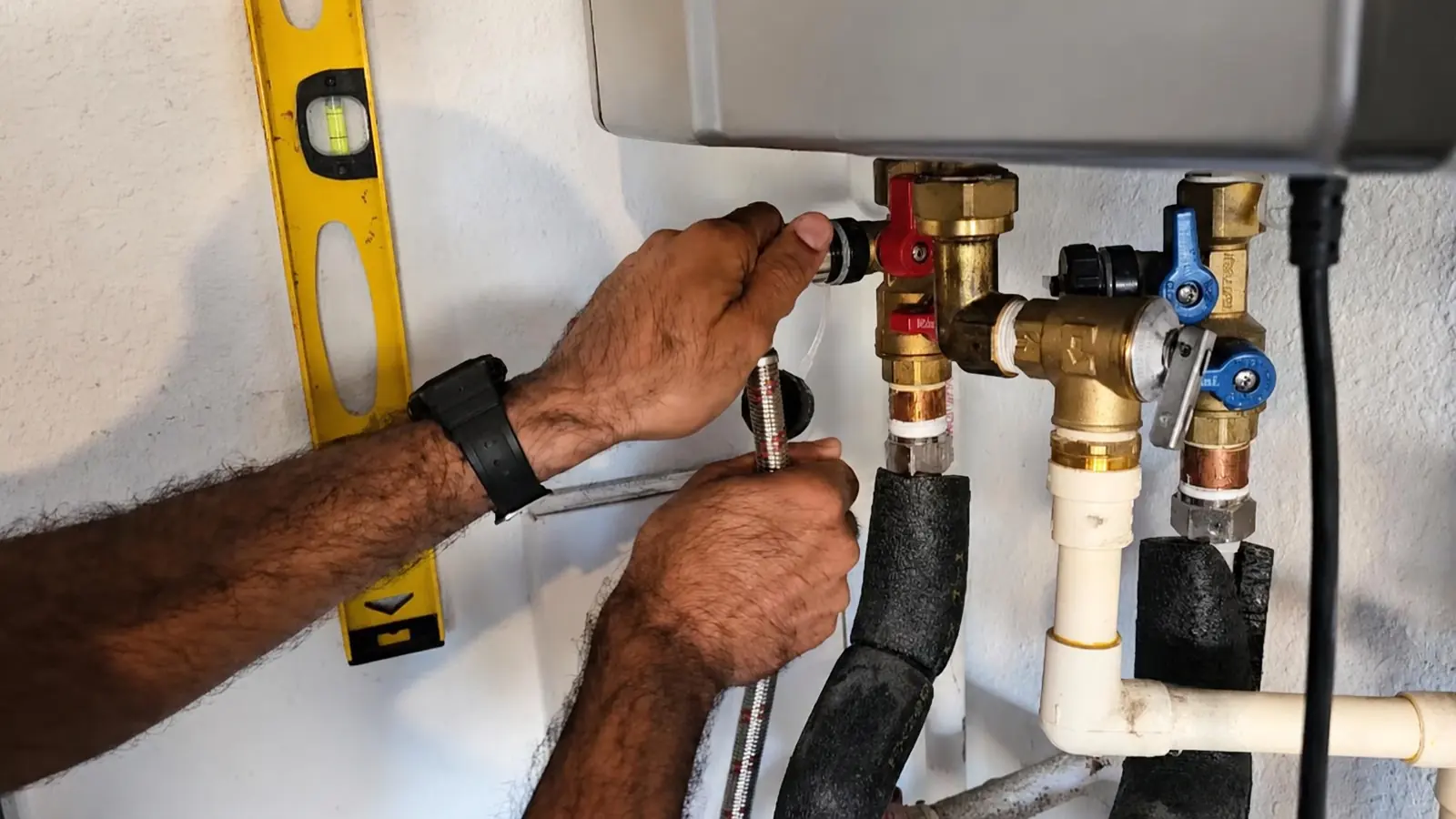
How an electric tankless heater makes hot water
A tankless electric unit has no tank. When you open a hot tap, a flow sensor detects water moving, and heating elements switch on to raise the temperature as the water passes. The unit modulates power to hold a set temperature, so a failing element shows up as water that is not hot enough at higher flow.
Most units have two to four elements, and a unit can keep running on fewer. That is why a partly failed heater often delivers lukewarm water for weeks before it fails completely, and why it struggles when two fixtures run at once.
Signs that an element has failed or scaled
Lukewarm water at full flow
One or more elements may be dead or coated with scale.
Hot at low flow, cool at high flow
The unit cannot raise the temperature as flow rises.
Breaker trips
A shorted element or a loose connection can draw excess current.
Error code on the display
Many codes point to a heating element, sensor or flow fault.
Always shut off the breaker before anyone touches a tankless unit. These heaters draw large amounts of current, and the wiring is not a place for guesswork.
| Symptom | Likely cause | Next step |
|---|---|---|
| Lukewarm water | Scaled or failed element | Flush, then test elements |
| Intermittent cold bursts | Low flow or dirty inlet screen | Clean the screen, check flow |
| Breaker trips | Shorted element or wiring | Call a licensed plumber or electrician |
| Error code | Sensor or element | Look up the code, then call |
| No heat at all | Power or control board | Check breaker, then call |
Why hard water is hard on elements
Minerals in water come out of solution when heated and form scale on surfaces. In a tankless unit, scale coats the heating elements and the heat exchanger, so the elements work harder to deliver the same temperature. Over time, scaled elements overheat and fail.
A flush with a descaling solution circulates through the unit and dissolves the buildup. It is a routine maintenance step on any tankless heater, and isolation valves that allow flushing are well worth adding if the unit was installed without them.
Unit running lukewarm?
Call and describe the symptom. A plumber can tell whether a flush or a part is likely.
Water hardness and tankless units in South Plainfield
Middlesex Water, which serves portions of South Plainfield, reported average hardness of 157 ppm in its 2025 report, with a range from 90 to 308 ppm. That averages about 9 grains per gallon, high enough to justify a regular flush.
If your home is served by a different supplier, check its annual report for the hardness figure. A water softener upstream protects the unit, and a plumber can advise whether one makes sense for your house.
Source type: Utility water quality report (Middlesex Water, 2025)
What a plumber checks
A plumber starts by confirming power, flow and the error history. Next comes a check of the inlet screen, a flush if scale is suspected and a test of each element with a meter. A failed element can be replaced, and the unit tested under load.
If the heat exchanger is badly scaled or the unit is more than ten to fifteen years old, a replacement may make more sense than repeated repairs. Our water heater replacement page explains how to decide.
Repair or replace?
Elements are a modest part, and replacement is often worthwhile on a unit with years left. A unit with a cracked heat exchanger, a failed control board and a long history of scale is a different story. Ask for the price of each option and the warranty status.
If the household has grown and one unit cannot keep up, adding a second unit or switching to a different type may solve both problems. We serve Edison and Scotch Plains as well as South Plainfield.
Keeping a tankless unit healthy
Flush it on the schedule in the manual, and more often in hard water. Clean the inlet screen, keep the air intake clear and watch the display for early codes. A yearly service visit also checks connections and safety devices.
Questions to ask before you pay for a part
Ask whether the unit is under warranty and what the warranty covers. Ask how old the unit is and whether it has ever been flushed. Ask for the failed element or the test reading so you can see what was wrong. A clear explanation is a sign of an honest repair.
Ask also whether other elements are showing wear. Replacing one element in a scaled unit may only delay the next failure, so it is worth asking whether the heat exchanger and the other elements should be checked while the cover is off.
Standards note
Manufacturer installation guidelines and the state plumbing standard both govern a tankless installation, and electrical work on the unit should be done by a licensed professional. Never open the cabinet with the breaker on.
Tankless element questions
It depends on water quality and use. Elements in hard water scale faster and may fail sooner. A regular flush extends their life.
It is a job for a licensed professional because of the electrical load and warranty rules.
A shorted element or a loose connection can draw excess current. Turn the breaker off and call a plumber or electrician.
Often, in hard water. Softened water reduces scale on elements and the heat exchanger. A plumber can advise based on your water.
Follow the manufacturer's schedule and flush more often in hard water. Many homeowners do it about once a year.