
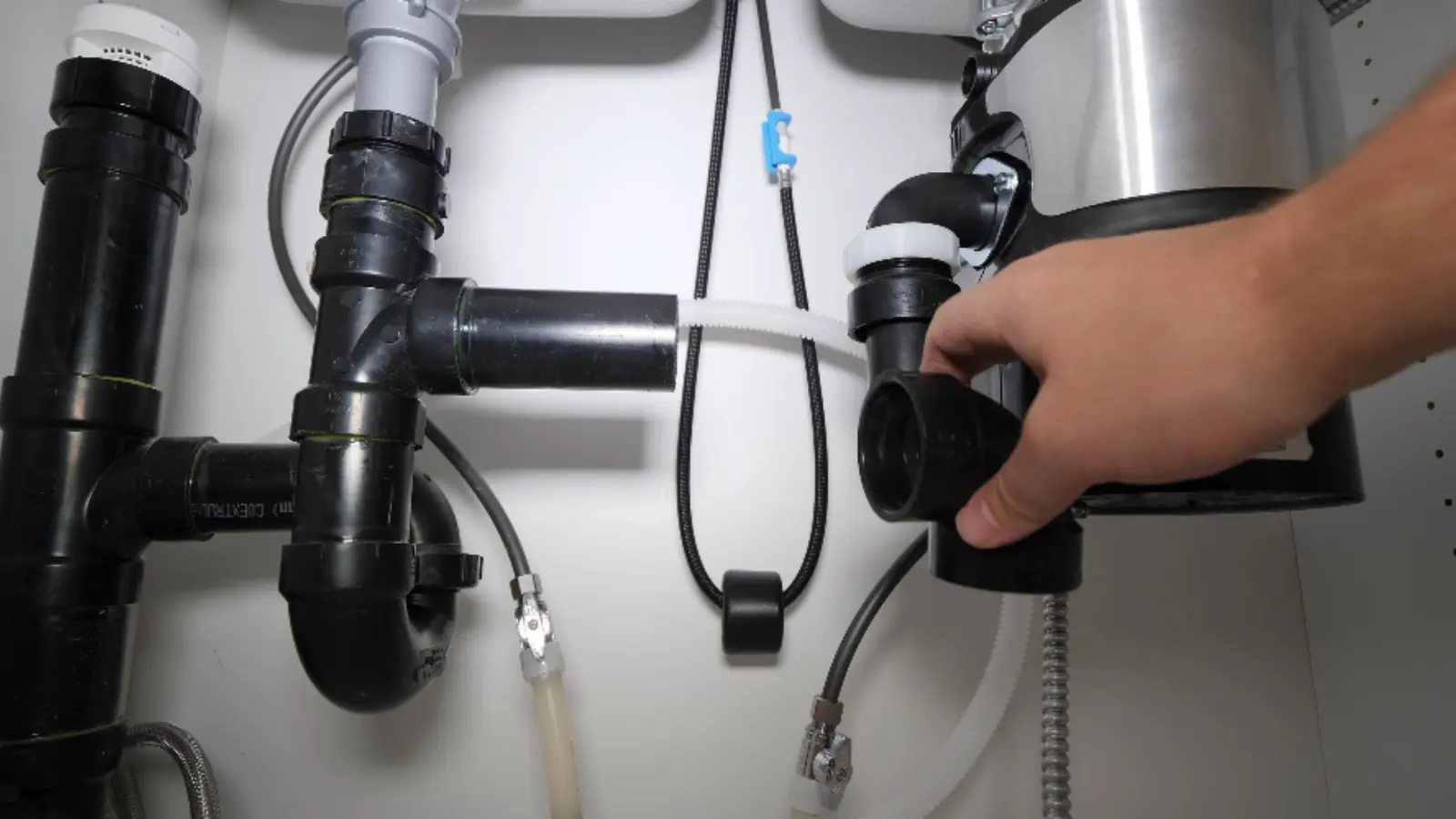
Before you buy: check the sink, the power and the drain
A disposal needs a standard 3.5 to 4.5 inch sink opening, a switched outlet under the sink, and a drain trap that can be adapted. Check cabinet depth too, since a disposal is several inches tall and a shallow cabinet or a sink with a deep basin may not leave room for the trap.
Pick a horsepower that fits your use. A third to half horsepower handles light use, while three-quarters to one horsepower suits a household that cooks a lot. A continuous-feed unit is the usual choice, and a batch-feed unit adds a stopper safety feature.
| Item | Why | Notes |
|---|---|---|
| Disposal unit | The appliance | Match horsepower to use |
| Mounting kit | Holds it to the sink | Usually included |
| Discharge tube and gasket | Connects to the drain | Often sold separately |
| Power cord or hardwire kit | Electric supply | Check local code |
| Plumber's putty | Seals the flange | Not silicone |
Installation steps
Remove the old drain
Disconnect the trap and remove the old sink strainer.
Mount the flange
Set the new flange in plumber's putty and tighten the mounting ring.
Hang the disposal
Lift the unit onto the mounting ring and lock it in place.
Connect the drain and power
Attach the discharge tube and plug in or hardwire the unit.
If a dishwasher is connected, knock out the plug inside the dishwasher inlet on the disposal. Skipping this step means the dishwasher will not drain. Run water and the unit for a minute and check every joint for leaks.
Prefer a pro for the install?
Call and a plumber can handle the mounting, the drain and the test.
Permits, licensing and who may do the work in New Jersey
New Jersey requires plumbing work to be done by a licensed master plumber or an employee of a licensed contractor, and the rules cover the license number on invoices and vehicles. You can verify a license at newjersey.mylicense.com/verification.
Permit rules vary by type of work, so ask the South Plainfield construction office whether a disposal install in your home needs one. Electrical work may fall under separate rules.
Source type: State licensing rule (N.J.A.C. 13:32) and N.J.S.A. 45:14C-1
Wiring and safety
A disposal needs a switched outlet or a hardwired connection. If no outlet exists under the sink, an electrician must add one. Never wire a unit to a circuit that does not match its rating, and always turn off the breaker before touching the wiring.
Water and electricity are a bad mix. Use a ground fault outlet where required, keep the cord clear of the trap and never run the unit while someone works near it.
Common problems after installation
Leak at the flange
The putty was too thin or the mounting ring is loose.
Leak at the discharge tube
The gasket is missing or the bolts are loose.
Slow drain
The trap or branch line is clogged, or the slope is wrong.
Humming but no spin
A jam, or the unit was dropped.
Most leaks are fixed by tightening a connection. A slow drain that persists after install points to a clog in the branch line, and our drain cleaning service can clear it.
Is a disposal right for your home?
A disposal reduces food waste in the trash, but it adds to the load on the drain and the sewer line. Grease, bones and fibrous scraps still do not belong in it. Homes with old cast iron or clay drains are more prone to clogs, so a camera look first is worth considering.
If your drains are slow already, solve that first. We serve Piscataway and Plainfield too, and a plumber there can handle the install in one visit.
Choosing the right disposal
Look at the grinding system, the motor size, the noise insulation and the warranty. Larger motors jam less and run quieter. A stainless steel grinding chamber lasts longer than plated parts. Compare the mounting system to your sink, since some systems fit more sink types than others.
Match the unit to how your household cooks. A single person who cooks occasionally has different needs from a family with several meals a day. A plumber can recommend a unit and install it, and bring the right drain parts for your trap.
Standards note
A disposal's wiring falls under the electrical code, the National Electrical Code (NEC) as adopted in New Jersey, and its drain must be trapped as the plumbing code requires. A licensed plumber and, where needed, an electrician keep both in line.
Disposal installation questions
An electrician must add a switched outlet or a hardwire connection. Do not use an extension cord.
A straightforward replacement takes one to two hours. A first-time install with wiring takes longer.
Yes. A single sink has one drain, which is simpler to connect than a double bowl.
Rules vary, so ask the South Plainfield construction office. A licensed plumber will tell you what applies.
Grease, bones, fibrous vegetables, pasta and rice in large amounts, and anything that is not food.