
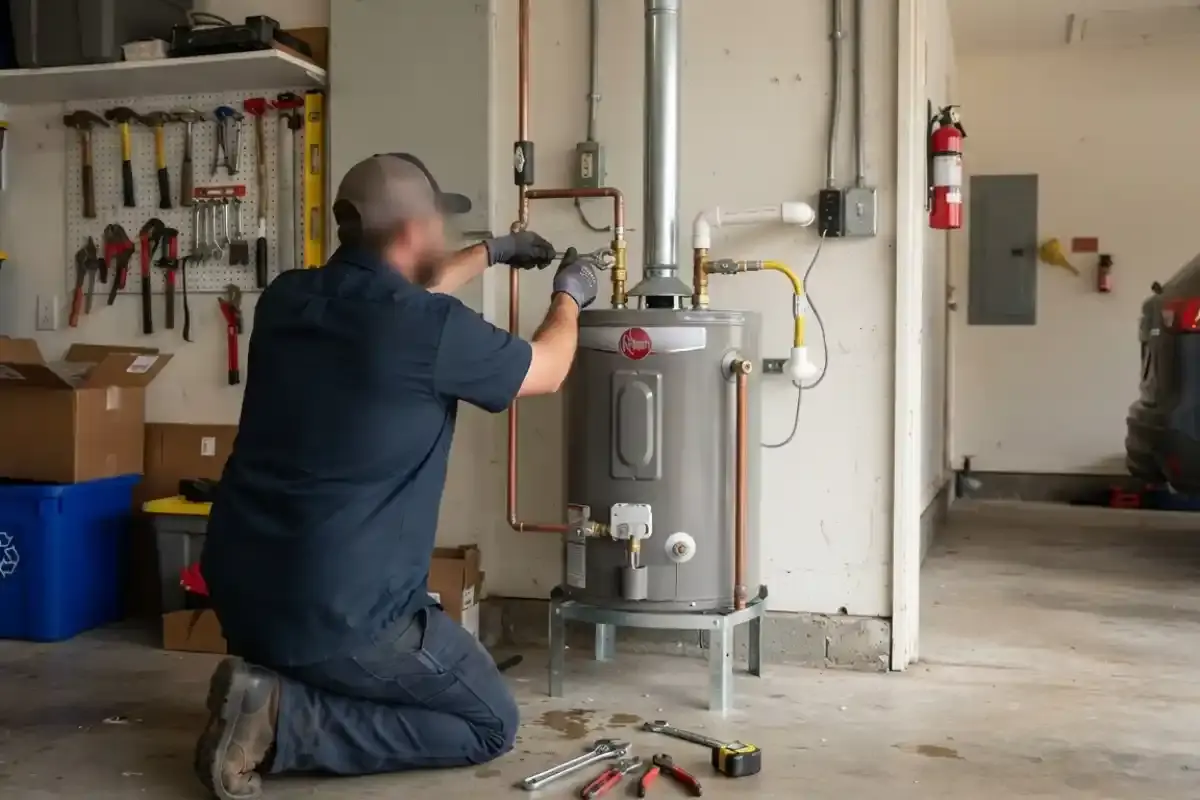
How a hybrid water heater works
A hybrid water heater looks like a tall tank with a heat pump on top. A fan pulls in air, a small compressor and refrigerant gather the heat from it and pass the heat to the water. Backup elements help when the demand is high, and most units let you pick a mode that balances savings and recovery speed.
Because it takes heat from the air, the unit cools and dries the space around it. In a warm basement that is a small benefit, and in a small closet it can be a problem.
What the install needs
Air space
Manufacturers generally call for a few hundred cubic feet of open air around the unit. Check the spec sheet.
Condensate drain
The unit removes moisture from the air, so it needs a drain or a pump.
Electric supply
A dedicated circuit is required, and some models need more than a standard tank.
Clearance
The unit is taller than most tanks, so check the ceiling height.
A plumber measures the space and the drain path before quoting. A finished basement with a utility room often works well. A tiny closet with no air flow does not.
| Factor | Hybrid heat pump | Standard electric tank |
|---|---|---|
| Operating cost | Lower in most homes | Higher |
| Purchase and install cost | Higher | Lower |
| Space and air needs | More | Less |
| Noise | Fan and compressor hum | Quiet |
| Recovery | Slower in heat pump mode | Fast with elements |
Considering a hybrid?
Call to book a visit and talk through the space and the numbers.
Basements, cooling and moisture in South Plainfield homes
Many South Plainfield homes have basements, and a basement is a typical place for a hybrid. The unit will cool the space slightly and remove some humidity, which can help in a damp room.
After Hurricane Ida in September 2021 flooded homes in the borough, many owners thought differently about what sits on a basement floor. A hybrid should sit on a stand above any chance of minor flooding, and the condensate drain must not be blocked.
Source type: News report (News12) and manufacturer installation guidance
Who is a good candidate
Hybrids suit households that use an electric tank now and have a basement or garage with room to spare. They are less attractive for a household that uses very little hot water or has no suitable space. If you have gas, a high-efficiency gas tank or tankless may be the better comparison.
Ask your utility about rebates and any tax incentives, which change from year to year. A plumber can give you the install price and you can compare it against the savings.
Noise, maintenance and lifespan
A hybrid hums, similar to a window air conditioner at low speed. Place it away from bedrooms. Maintenance is light: clean the air filter, flush the tank on a schedule and check the condensate drain. Lifespan is comparable to a standard tank when it is maintained.
Hard water matters here too. Middlesex Water, which serves portions of South Plainfield, reported average hardness of 157 ppm in its 2025 report, so a flush and an anode rod check are part of maintenance.
Costs, permits and the next step
A hybrid costs more upfront than a standard tank, and the savings accrue over time. A plumber should give you a clear price that includes the unit, the drain work and any electrical changes. Permit rules vary, so ask the South Plainfield construction office.
If your tank has already failed, see water heater replacement for the fast route. We also serve Piscataway and Edison.
Questions to ask before choosing a hybrid
Ask the plumber about the first-hour rating, the sound level, the condensate path and the mode that suits your household. Ask what happens in a power outage and whether the unit has a vacation mode. Ask also how the unit performs when the basement is cold, since efficiency drops in cold air.
Compare the total price, not just the unit. A hybrid's install can include a new circuit, a drain pump and a stand. Ask for each item listed, then compare against a standard tank and decide how long you plan to stay in the house.
Maintenance schedule at a glance
Clean the air filter every few months and check the condensate drain for clogs. Flush the tank once a year, and check the anode rod every few years in hard water. Listen for changes in the fan or compressor sound, which can signal a problem early.
Standards note
Look for the ENERGY STAR label, which marks water heaters that meet efficiency guidelines set by the U.S. Environmental Protection Agency. Ask for the model's first-hour rating and its sound level before you buy.
Hybrid water heater questions
They need more than a standard tank. Manufacturers commonly specify several hundred cubic feet of air space. A plumber can check yours.
They hum, comparable to a window air conditioner at low speed. Keep them away from bedrooms.
Efficiency drops in cold air, and many units switch to elements in cold conditions. A heated basement works better.
Often, for an electric household with room. The basement air supplies heat, and the unit also helps with humidity.
Yes, if sized correctly. Ask about the first-hour rating and the recovery time.